Home | Price List | Brochure | Cart | Delivery | FAQ | VAT | Contact Us | Terms
Pharmacy Refrigeration
Healthcare Refrigeration
Laboratory Refrigerators & Freezers
Economy Range & Ice Makers
Low Temperature Freezers
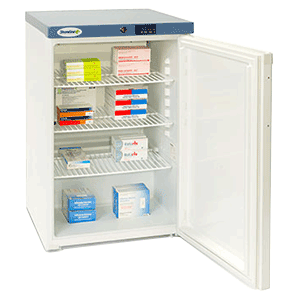
Pharmacy fridge
To request prices or if you have any questions please feel free to contact us. Alternatively please submit the enquiry form and we will contact you within 24 hours.
Frequently Asked Questions
Q1  So why shouldn't I go down to my local electrical superstore and buy one there?
A1  Is a fair question if you believe your requirements are reasonably simple, and one we are often asked. Our first response is usually: "Is the temperature at which your samples are stored of importance, and will the performance of a domestic refrigerator be good enough?"
Domestic products are carefully designed to store food items and at the same time conform to the many and various regulations that pertain to that function. Laboratory requirements are not necessarily exactly the same as those of a household kitchen and the value of the samples being stored, if only in people's time, its normally much higher; often greatly exceeding the cost of the fridge freezer in which they are stored. They are your samples, why take the risk by putting them in something built for a different purpose?
Q2  OK, but how do I choose the right Labcold product from all these options?
A2  No one wants to spend more money than they need to, but it could be an expensive mistake to spend too little on something unsuitable. In general you will pay for a larger model; a better performance or specification; or a higher level of construction. The following might help you narrow down the options.
  Operating Temperature
  Is normally dictated by your application. Labcold refrigerators have nominal operating temperatures set to between 3 and 5°C depending upon the product. There is some user adjustment possible around these temperatures but alteration from standard may interfere with the automatic defrosting or produce unexpected alarms.
Labcold offers freezers operating at several temperatures from -20°C to -196°C. Knowing what temperatures is required by your application will immediately narrow the range of your options.
  Size
  Can depend upon several factors; your budget; how much storage space you need, both now and in the future; where the product is located; how large a cabinet can actually be got through the doorway/ into the lift/ up the stairs/ round the corners on route to its final resting place. When choosing the location for a fridge or freezer please remember to allow a suitable amount of space around it for ventilation otherwise it will not perform correctly.
  Performance
  This aspect is often less well understood by users than other factors. Scientists are familiar with working with high precision devices and are sometimes dismayed to find that it is not possible to make a fridge or freezer operate to the same temperature tolerance as, say, an incubator. Two interrelated functions must be taken into account:
 
  • Control precision: Most refrigeration systems use electric motors to compress the refrigerant gas into a liquid which in turn is allowed to evaporate, and so cool the chamber. Electric motors cannot be switched on and off rapidly like a heater, and there is also a degree of over and undershoot inherent in the gas/liquid transition. The result is a temperature fluctuation at all points in the chamber on a regular basis. Careful attention to system design, microprocessor controllers and higher specification materials can all be employed to minimize this fluctuation but at best it will be approx. +-1°C and usually significantly more.
  • Spacial temperature variation: Cold air is more dense than warm and so naturally sinks to the bottom of the chamber resulting in a temperature gradient. For this reason refrigeration systems may be designed with more cooling towards the top of the chamber to attempt to counteract this phenomenon but with variable levels of success. Additionally the temperature just inside the door (or lid) is normally higher than deeper inside the chamber. Both of these factors added together mean that at any one time there are variations in temperature between different points in the chamber. This variation can be significant in a tall unstirred chamber (perhaps as much as 1-2°C per vertical 50cm) and is minimized by selecting a short chambered, or chest product or by use of a circulating fan.
  • Temperature uniformity: is the combination of the above factors measured over a period of time and is established by temperature mapping the chamber.
  Safety
  Fire Service records show that the single most common source of fires in laboratories is refrigerators or freezers. Flammable vapours can originate from unexpected sources and it takes a very small amount to cause an explosion risk. Users may not realize the potential hazard and yellow stickers on the door are of limited deterrent value. If there is a remote possibility that a potentially flammable material or component might find its way into the fridge or freezer during its lifetime then you should always select from the Sparkfree models.
Q3 How is the product to be used?
A3 Fridges and freezers used in hospitals and laboratories are often subject to much harder use than in other environments. Frequent and/or prolonged door openings can often lead to difficulties in temperature maintenance, ice build up and greater wear and tear. Shelves can be overloaded causing distortion, and freezers often go many months without defrosting causing the refrigeration system to work harder.

Labcold offers heavy-duty and higher performance options which could cope better and last longer in demanding environments whilst delivering levels of temperature control more in keeping with a scientific or medical application.

It is therefore worth giving consideration to the application and environment in which the fridge or freezer is to be used, and the abuse to which you anticipate the product may be subject.
  Operating environment and location?
  Refrigerators and freezers work by ejecting heat energy from their chambers to the surrounding atmosphere, their refrigeration systems also generate heat themselves which also needs to be dissipated. Some systems employ an electric fan to cool their condensers; others simply rely on air convection. In either case there needs to be free movement of air around the product, particularly at the back and around the compressor area and so the space planned for a new fridge freezer needs to be appropriately larger than the product itself, and is often inappropriate to push the back of the cabinet up against the wall.

It is also important that the surface on which the fridge or freezer is to stand is level, and the ambient temperature in which the unit is to operate should be neither too high (Labcold products are rated for various different maximum ambient temperatures) or surprisingly, too low - most products will not operate correctly as at ambient temperatures below 10°C. Please also consider if there are likely to be other factors in the proposed location such as direct sunlight, radiators, heating pipes or ducts etc. all of which will adversely affect performance.

We can advise you of what is appropriate to individual products on these and other aspects if you are in any way concerned.
  Options And Accessories
 
  • Additional Shelves: are available for many Labcold products to increase storage capacity.
  • Sample storage racking: can greatly increase the numbers of samples a given freezer will hold and aids location and retrieval of samples. It also improves temperature uniformity and it reduces cold loss on door opening. Customised racks can be made to suit both your samples and a particular freezer. Colour coding is also possible.
  • Door locks: most Labcold products can be fitted with a door lock, if not fitted as standard, to aid sample security.
  • Access ports: are available in two sizes and can be fitted to many Labcold products to allow temperature probes, tubes or wires to pass into the chamber with minimal disturbance to operation performance.
  • Alarms and displays: to advise if your samples are at risk.
  • Chart recorders or data loggers: provide a record of the storage environment your samples have experienced.
Q4  So what should I do when my product is delivered?
A4  The following is an extract from notes included with every labcold product:
 
  • Acceptance: Immediately upon delivery to you the product packaging and the product itself should be inspected for any signs of damage. It was perfect when it left us and should still be so when you receive it. If this is not the case please contact Labcold, or your supplier immediately or at most within three days of delivery.
  • Positioning: Units should be positioned so as to allow adequate airflow around the refrigeration compartment. Once in its final position for use the equipment must be left to stand for at least 2 hours (24 hours for ULT and Super-freezers) before being switched on to prevent damage to the refrigeration system.
  • Stabilisation: Following the above resting period the equipment can be switched on and left for at least 24 hours to cool down, and the temperature to stabilize. After this time the unit should be checked for correct operation. Only following this should the product be used for the storage of material.
  • Calibration: If desired, and following steps 1 to 3 above, the operating temperature inside the chamber (at the centre) may be checked against an independent thermometer of verified accuracy. Any adjustment necessary can then be made by reference to the appropriate section in the operators manual. All Labcold products have their operating temperatures factory set when being built but following transport, or when being operated in a different environment, small adjustments are sometimes necessary. Such adjustments are intended to be performed by the user and are not covered by the warranty.
 www.medical-fridge.co.uk - Links 0208 099 3568